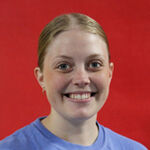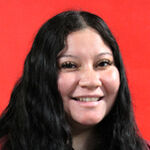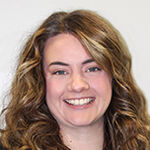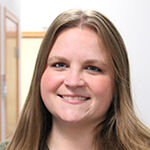
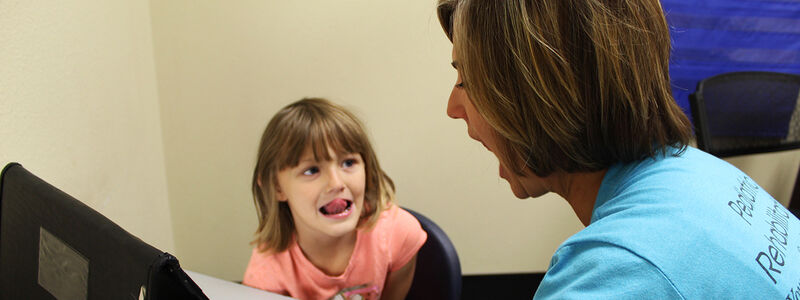
Speech Therapy Mary Lanning Healthcare’s Pediatric Speech Therapy Department treats speech, language and swallowing conditions and disorders for all ages. Services are individualized using comprehensive assessments, treatment modalities and approaches. Mary Lanning Healthcare’s Speech-Language Pathologists (SLPs)
are licensed and certified by the American Speech- Language and Hearing Association (ASHA) – the most respected voice for communication sciences and disorders.
Is your baby struggling to feed at bottle or breast? Mary Lanning’s Pediatric SLPs can help with improving oral motor function and suck training to reduce symptoms such as:
Our SLPs know when to refer to other providers such as lactation consultation, an Ear Nose and Throat (ENT) Specialist, a pediatric dentist or preferred provider for further assessment of possible lip, tongue, or cheek restrictions, gastroenterology, occupational or physical therapy, or a chiropractor.
Myofunctional therapy is individualized therapy to help each patient retrain muscle function, create and maintain a healthy orofacial environment. Signs and symptoms that your child may benefit from myofunctional therapy include:
Treatment may include:
Appropriate Treatment Population includes:
The myofunctional therapist serves as the “tour guide” for the entire process.
The best outcomes are achieved when the entire family is involved in the myofunctional therapy program and parents/caregivers are directly involved in therapy.

On October 22, 2025, Teresa and Jay Canada’s son, William, was born at Mary Lanning Healthcare without a heartbeat. Here is their story:
“In the middle of one of the most terrifying experiences of our lives, we were surrounded by people who never stopped fighting for our son: The doctors. The nurses. The specialists. Literally, the entire Second Floor hospital staff. Twenty-eight minutes of CPR later and much, much praying with the Good Lord, we were assured William was going to live.…
Read More
Shay Burk had not given much thought to stroke before the day her husband, Tim, suffered one in their Hastings backyard. But she did know the symptoms. That knowledge, teamed with Shay’s confidence in Mary Lanning Healthcare, reinforced that she was doing the right thing by calling an ambulance.
After arriving at MLH, one of 11 Certified Primary Stroke Centers in Nebraska, Tim was rushed in for a CT scan. Dr. Maxwell Nyce, neurologist, was on hand to order administration of a clot-busting…
Read More
Like most first-time parents, Enya Young of Deshler was a little nervous about delivering her baby. One of her concerns was whether having a baby at Mary Lanning Healthcare, rather than a smaller hospital, would mean an impersonal experience.
What the Superior native learned was that the MLH Family Care Center strives to make their patients feel special.
“Everyone there really gave it a small-town feel,” Enya said. “It was that small-town energy that I loved.”